
Taxation Form in Poland: Lump Sum, Progressive Scale or Flat Tax
Taxation Form in Poland: Lump Sum, Progressive Scale or Flat Tax
Taxation form in Poland is one of the most important decisions for entrepreneurs planning to run a business in Poland. The chosen model directly affects tax liabilities, accounting complexity and the overall financial security of the company.
From legal practice, it is clear that tax problems usually arise not because of high rates, but due to an incorrectly selected taxation model that does not reflect the real income and cost structure of the business.
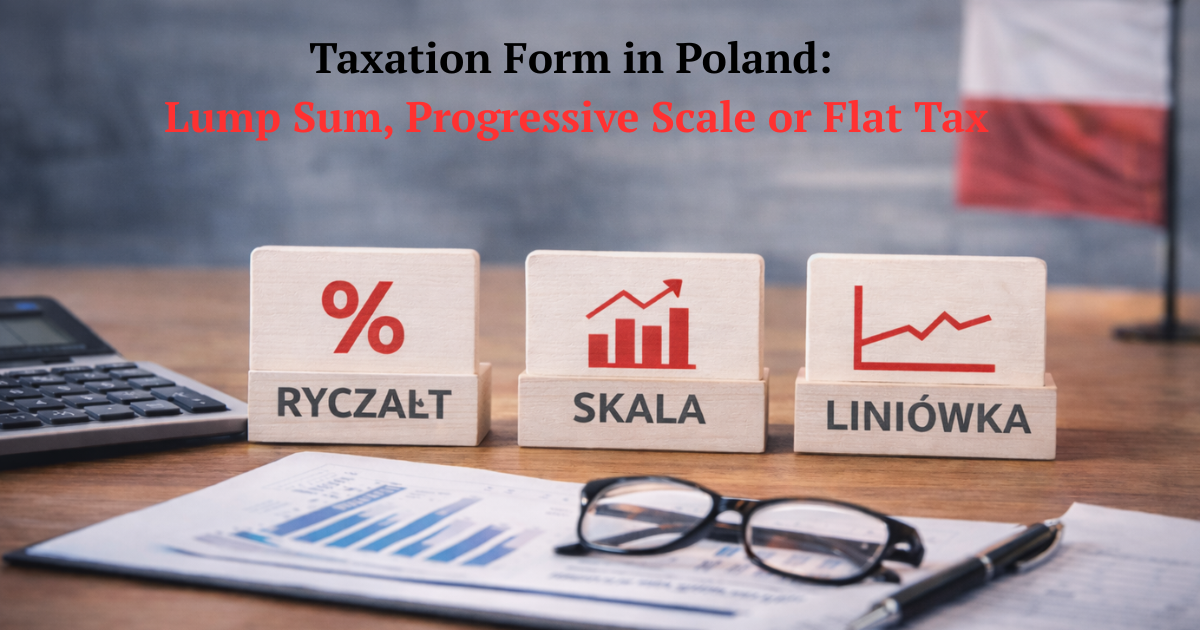
Available taxation forms for business in Poland
Polish tax law provides three main methods of business taxation: the progressive tax scale, the flat tax and the lump sum on registered revenue. Each option has its own calculation rules, advantages and limitations.
Choosing taxation for business activity
When selecting a tax solution, entrepreneurs should consider not only the tax rate itself, but also the possibility of deducting expenses, long-term growth plans and expected income levels.
Progressive tax scale
The progressive scale applies tax to net income after deducting documented business expenses. The rate is 12% up to PLN 120,000 per year and increases to 32% once this threshold is exceeded.
This taxation method is often beneficial for businesses with significant operating costs, such as office rent, equipment purchases or outsourced services.
Flat tax (19%)
The flat tax applies a fixed 19% rate regardless of income level. This option provides predictable tax planning, especially for entrepreneurs with higher earnings.
However, it should be noted that the flat tax limits access to certain tax reliefs and excludes joint tax settlement with a spouse.
Lump sum on registered revenue
The lump sum tax is calculated on total revenue without deducting expenses. The rate depends on the type of business activity (PKD code) and may be as low as 5.5% in selected industries.
This option works best for businesses with low operating costs and a simple financial structure.
Comparison of taxation methods in Poland
In practice, entrepreneurs compare taxation options not only based on rates, but also on accounting simplicity, financial predictability and the possibility to change the taxation form once per year.
- expected income level and stability,
- amount and structure of deductible costs,
- business development and scaling plans,
- need for simplified accounting.
Current tax rules and rates are published on the official website of the Polish Ministry of Finance: podatki.gov.pl.
Legal conclusion
A properly selected taxation method allows entrepreneurs to reduce tax risk, optimize financial obligations and ensure stable business development in Poland.
If you have doubts, it is advisable to seek professional tax and legal consultation in Poland before choosing or changing your taxation form.







Leave a Reply