
VAT in Poland: When You Need to Register as a VAT Payer
VAT in Poland: When You Need to Register as a VAT Payer
VAT in Poland is one of the key taxes that almost every entrepreneur will encounter. Proper understanding of VAT rules affects not only the amount of tax liabilities but also business security, cooperation with contractors, and the ability to open a bank account.
From legal practice, I can say that most problems arise not because of the tax itself, but due to late registration or incorrect application of VAT rates. That is why the decision to register as a VAT payer should be made already at the business planning stage.
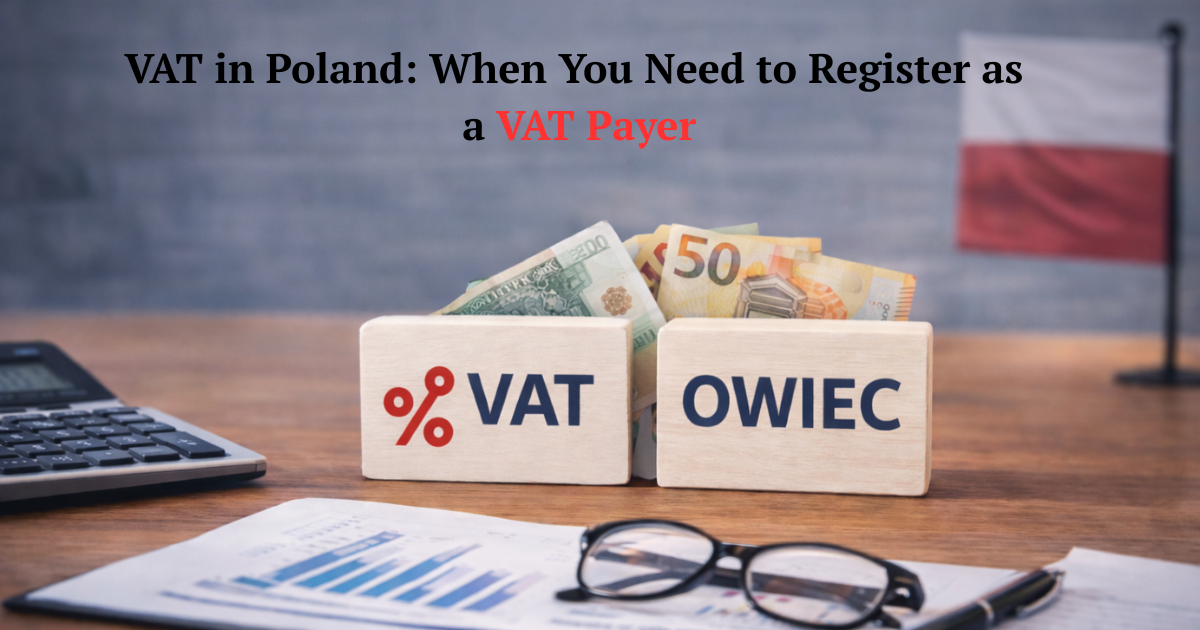
VAT in Poland
Value Added Tax (VAT) regulates the obligation to charge and pay tax on the sale of goods and services. An entrepreneur registered as a VAT payer is required to issue VAT invoices and submit regular tax reports.
VAT Rates in Poland
VAT includes several main rates:
- 23% — standard rate;
- 8% — reduced rate for selected goods and services;
- 5% — for specific categories of products (e.g., books or certain food items);
- 0% — for intra-EU transactions, provided VAT UE requirements are met.
Current VAT regulations and rate rules are available on the official website of the Polish Ministry of Finance: podatki.gov.pl.
When VAT Registration Is Mandatory
Registration as a VAT payer is mandatory if annual turnover exceeds PLN 200,000. Once this threshold is exceeded, the entrepreneur must submit the VAT-R form and switch to the general VAT regime.
Mandatory registration also applies in cases of:
- providing services to VAT taxpayers in other EU countries;
- purchasing or selling goods within the European Union (VAT UE);
- conducting activities that are not legally exempt from VAT.
Voluntary VAT Registration in Poland
Even if turnover is below PLN 200,000, an entrepreneur may voluntarily register as a VAT payer. In many cases, this is beneficial, especially if the business has significant purchasing costs or cooperates with other VAT-registered companies.
The main advantage is the possibility to deduct input VAT paid to suppliers from output VAT liabilities.
VAT and VAT UE
It is important to distinguish between domestic Polish VAT and VAT UE. If a company carries out cross-border transactions within the EU, it must register for VAT UE and submit additional reports.
Incorrect invoicing or reporting may lead to financial penalties and tax inspections.
Legal Conclusion
VAT in Poland is not just a technical obligation but a strategic element of tax planning. Timely registration, correct rate application, and proper reporting allow entrepreneurs to avoid penalties and ensure stable business operations.
Before making a decision regarding VAT registration, we recommend seeking professional tax consultation in Poland to minimize risks and properly plan your financial model.





Leave a Reply