
Registering a Business in Poland for Ukrainians in 2026
Poland remains one of the most convenient entry points into the EU for a Ukrainian entrepreneur: a shared border, a large diaspora, simple logistics and a market that understands the Ukrainian customer. But 2026 brought a change that cannot be ignored — the end of the special regime for Ukrainians.
What changed on 5 March 2026
Poland is winding down the 2022 special law that, at the start of the full-scale war, allowed Ukrainians to stay, work and open a business on the mere fact of entry, with no extra permits, and is moving them onto the general rules for foreigners.
If you opened a business before 4 March 2026, it keeps running without obstacles. But if you are only planning an activity similar to the Ukrainian sole proprietorship (hereafter JDG, jednoosobowa działalność gospodarcza), there are changes for you. Previously, the mere fact of legal residence granted the right to register. Now the principle is stricter: if there is a legal basis, JDG is allowed; if there is none, registration is impossible.
Which grounds grant this right after 5 March:
- UKR status (a valid PESEL UKR) — a separate, standalone basis that preserves access to JDG on the old terms;
- permanent residence card (pobyt stały);
- EU resident card;
- Pole's Card (Karta Polaka);
- residence card based on marriage to a Polish citizen;
- residence card for family reunification;
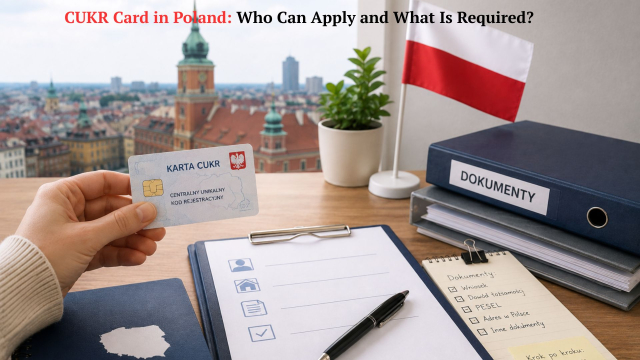
- CUKR card obtained before 4 March 2027.
However, if a person is in Poland only on the basis of a temporary residence card without the right to economic activity, they will not be able to register a JDG, regardless of how long they have lived there.
Which business forms are available
JDG is the simplest and cheapest option: registration is free, reporting is minimal, accounting is simplified. The "price" of that simplicity is that you are liable for the business's obligations with all of your personal assets.
Sp. z o.o. (the equivalent of a limited liability company) removes this risk: it is the company, not the founder, that is liable for debts. Anyone with a foreign passport can set up such a company — citizenship or a residence permit are not required. So if your status does not grant the right to a JDG, an Sp. z o.o. often becomes the legal workaround. The downside is mandatory full bookkeeping, which is more expensive to maintain.
A separate option is a business incubator (inkubator przedsiębiorczości). You work under a legal "umbrella": the incubator issues invoices to your clients and keeps the accounts, while you earn income without your own company. The format suits those who provide services on their own — designers, copywriters, marketers, programmers — to test a venture at the start or to legalise freelancing when there are no grounds to open a JDG yet it is still too early to set up a company.
How much it costs and what taxes apply
Registering an Sp. z o.o. through the S24 system is the cheapest route: 250 zloty to enter the KRS and 100 to publish in the Monitor Sądowy i Gospodarczy. To that you add share capital of at least 5,000 zloty, which remains the company's property, and PCC of 0.5% of the capital — from 25 zloty.
Taxation of an Sp. z o.o. is CIT, the company income tax, which is 9% for small taxpayers with annual income up to EUR 2 million and 19% for the rest.
For a JDG, the chosen form of taxation determines the rate:
- the scale (skala podatkowa, general rules) — 12% on income up to 120,000 zloty and 32% on the amount above that, but the first 30,000 zloty per year are tax-free;
- flat tax (podatek liniowy) — a single 19% rate on all income, with no tax-free allowance or reliefs;
- lump sum (ryczałt) — the tax is calculated not on profit but on turnover, and the rates depend on the activity; for IT, for example, it ranges from 2% to 17%.
A separate cost item is ZUS contributions (Zakład Ubezpieczeń Społecznych), the Polish equivalent of the pension fund and social-insurance institutions. The full contribution in 2026 is 1,773.96 zloty per month, not counting the health contribution. But a newcomer gets reliefs: ulga na start gives the first 6 months free of social contributions. After that, the preferential ZUS applies — 456.18 zloty per month for 24 months.
Risks
The biggest danger for a newcomer is misjudging their own status. Say a person is sure they will open a JDG without obstacles, but their temporary residence card no longer grants that right. So check the basis of your stay before you pay for registration. It is equally risky to choose a business form at random: calculate it against your real turnover rather than copying someone else's scenario. And remember that temporary protection ends on 1 September 2026, so the transition from UKR status to a residence card is worth planning well in advance, not in the final week.
How we help
Our team handles most legal aspects of doing business in Poland and supports Ukrainians with legalisation: we set up your company without your presence, choose the right form for your situation, keep your accounts and arrange residence cards. Start with a consultation — it will save you more than it costs.
FAQ
Can Ukrainians open a business in Poland in 2026?
Yes. An Sp. z o.o. (equivalent of an LLC) is available to anyone with a foreign passport. A JDG (equivalent of a sole proprietorship) is available to those who hold UKR status or another basis that allows economic activity.
Which business forms are available to foreigners in Poland?
The most common are the Sp. z o.o. and the JDG. There are also limited partnerships, joint-stock companies and others. For freelancers there is a business incubator — working without registering a company.
What documents are needed to start a business in Poland?
For an Sp. z o.o., a foreign passport is enough. You additionally arrange a PESEL number, a qualified electronic signature or a trusted profile, and a registered address. For a JDG you need a document confirming the right to economic activity (UKR status, a permanent residence card, etc.).
How much does it cost to open a company in Poland in 2026?
If you set up an Sp. z o.o. through S24, registration costs about 350 zloty in state fees. You also need share capital of at least 5,000 zloty and must pay PCC of about 25 zloty. Registering a JDG is free.
What taxes do entrepreneurs pay in Poland in 2026?
Taxes for an Sp. z o.o. are CIT of 9% or 19%. JDG entrepreneurs pay 12% or 32%, flat tax 19%, or lump sum 2–17% — their choice. On top of that, you must pay ZUS contributions and the health contribution.



Leave a Reply